Showing posts with label Kentucky. Show all posts

Monday, August 18, 2014

Soldiers' Mail

Joseph Kenedy Masterson, my grandfather, was inducted into the U.S. Army and sent to Europe in July 1918 as part of the American Expeditionary Forces. He was 23 years old.

Grandpa was born and raised in New Hope, Kentucky, a tiny farming town. Everybody in and around New Hope not only knew everybody else, but the chances that they were cousins were very high. Ken met and began courting Mary Ethel Peake of New Haven (six miles from New Hope) before being drafted into the military.

Grandpa corresponded with Ethel while he was away–she kept all his letters and postcards. He closed his first letter to her written from boot camp with "lots of love & kisses to my sweet little Wife" and addressed her as "Dear" and "Deariest" in all of his correspondence during the War. Although he tended to tease her about flirting with the French and German girls, it was obvious from his letters that he was lonely and was anxious to return home to marry her.


The postcard to the right was postmarked July 30, 1918. Notice he wrote a "K" (for Ken) on the soldier's sleeve and an "E" (for Ethel) on the woman's sleeve. Under the printed words of GOOD-BYE, SWEETHEART he wrote "Until this war is over over there." At the bottom of the card he wrote "From your little one Dear excuse writting [sic] as I am on the train and cant steady my arm." On the other side of the postcard, he wrote:
"Hello Ethel how are you. Well I am on my way but I don't know where. We just passed through Paducah & sure had a nice time there. The Red Cross girls gave us all the ice cream we could eat & the best of all they gave us there addresses & told us to be sure & write to them. haha"


The next card we see is a Safe Arrival notice postmarked August 1, 1918.


Every letter from that point on was reviewed and signed off by a censor.  Below shows that the censor approved this letter from January 15, 1919 by signing on the last page of the letter and on the envelope.


Knowing that his letters would be read by a stranger must have made it very awkward for Ken to express any tender feelings he had for Ethel. But on March 31, 1919, he expressed his concern that she would not wait for his return.


"...if the girls keep marring [sic] like they have been, there won't be any one left for me, for I know the next marriage I hear of, will be you. I am ...


"...looking every day for some one to send me the clippings saying you have gotten married, so then I know I will be out of luck. But dear, dont forget me, for I wont always be in this God forsaken country, I'll be coming back to you some day, or at least I hope so."
This letter was four pages long and across the top, one word per page, he wrote: "I'll Keep My Promise."

Ken was discharged from the Army on May 21, 1919 and, after a short visit home with his family, he went to Copley Township, Illinois, to work as a hired hand on a farm where he had often worked before being drafted. Ethel's father moved their family to St. Augustine, Illinois, in 1920, which brought them within 35 miles of each other. Ken would travel to St. Augustine by train and Ethel would come into town to spend the day with him. They were married on December 29, 1921.

I never met Grandpa–he died at the age of 48, when my father was ten years old. If it hadn't been for the Soldiers' Mail, we would not have known him at all.

Visit the Sepia Saturday blog to see other letters home from the front, or from school, or from summer camp.


Thanks for dropping by.

Sunday, February 10, 2013

Black Sheep Sunday: Philanderer, Deadbeat, Kidnapper, and Child Trafficker

James Proctor Clark and Caledonia (Callie) Adeline Hurt were married on 20 June 1910 in Louisville, Jefferson County, Kentucky. They had three sons: James Proctor (Jim) Jr., Joseph Woodrow, and Norwood Francis. The family moved frequently between 1910 and 1918, first to Covington, Kentucky, then back to Louisville, and finally to Dayton, Ohio. While in Dayton, Callie obtained a divorce in April 1918 on the grounds of cruelty, neglect and abandonment and was awarded full custody of the boys. Although the court did not order visitation rights for Proctor, Callie allowed him to see them from time to time.

Finding herself the sole support of the children, Callie went to work at Dayton Wright Airplane Company sewing fabric on the airplanes. There were no daycare centers for children of working mothers in those days. The judge that granted the divorce suggested that the three boys be placed in St. Joseph’s Orphanage while she was at work. They usually resided at the orphanage during the day, but occasionally were there overnight when their mother worked the 12 hour shift.

Female employees of the Dayton-Wright Airplane Company
working on the skeleton of an aircraft wing at Plant 1
February 23, 1918

The nun in charge of the orphanage did not trust Proctor and warned Callie not to allow him access to the children. However, for reasons unknown, Callie continued to allow the father to visit their children at the orphanage. In November 1918, the boys were playing in the orphanage’s yard when Proctor arrived and “induced them to come to the street and enter an automobile.” Jim was seven, Joseph was five, and Francis was two when they were abducted.

Proctor was living with Irene Clarke, who was named in the divorce, and their infant son George (Oscar) at the time of the abduction. Irene and George fled to Iowa with Proctor and his sons where they opened a restaurant. Proctor eventually told the boys that their mother was dead. The restaurant went bankrupt and the family left town owing money. They repeated this pattern in several other towns until they arrived in Monroe, Louisiana where Proctor changed his name to Charles Williams and opened a grocery.

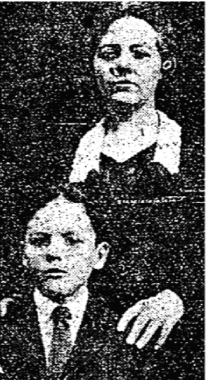
In 1922, Jim’s father sold the eleven year old to a farmer in El Dorado, Arkansas as a laborer. Jim ran away from the farmer and made his way to Natchez, Mississippi where he was apprehended by the sheriff. He told his story, including that he was told his mother was dead. Jim remembered his mother’s and grandmother’s names in Louisville which allowed the Natchez Chief of Police M. P. Ryan to locate them and inform them that Jim was found. Callie, by now remarried to Eddie (Les) Reid and living in Louisville, immediately left for Natchez, a two-day trip by train, to be reunited with her eldest son.

Callie and Jim. Photo from Times-Picayune
newspaper, September 29, 1922, page 1
Chief Ryan of Natchez traced Charles Williams to Monroe. The Monroe chief of police established that Charles Williams was living in Monroe with several children and took temporary custody of them. Callie took Jim with her to Monroe to determine whether those were her other two sons. The younger boys were turned over to her on September 29, 1922 after proof of custody was provided from the Dayton courts.

The Monroe police received another telegram on that same day from Mr. and Mrs. Jean Clarke, parents of Irene and grandparents of 4-year-old Oscar. They were on their way to Monroe from Dayton to "take charge" of their daughter and grandson and were expected to explain the "cryptic message to hold Mrs. Irene Clarke and boy."

The Dayton court set out a warrant for Proctor’s arrest but before the arrest could be made, James Proctor Clark, Irene Clarke, and their son Oscar disappeared leaving behind several hundred dollars worth of groceries and other goods. The expected explanation from Irene's parents was never reported in the tabloids.

Callie and the children returned to Louisville, Kentucky. She lived in Kentucky until her death in 1993 at 100 years of age.

The boys never saw their father again, however there were some reports of him in later years. One was in the summer of 1936 when he introduced himself to a nephew in Bardstown, Kentucky and said he was there to “have a last look around.” Another time was in Chicago where he was reportedly a painter in the 1940s. He may have returned to Dayton, living with a woman that was not Irene, from 1933 to 1948. His son Francis (now named Steve) received a letter from the Social Security Administration stating that Proctor died in January 1962.


James Proctor Clark, Sr.: philanderer, deadbeat, kidnapper and child trafficker–my 2nd cousin twice removed and the blackest sheep I hope to find in my family tree. He sounds like a very shady character, indeed. I have to admit that I'm glad I don't share much DNA with him.

Thanks for dropping by.
Black Sheep Sunday is a daily blogging prompt from GeneaBloggers.


Bibliography

  1. Louisiana: New Orleans States newspaper, “Mrs. Reed Finds Kidnaped Boys”, September 27, 1922, page 19, column 7 (http://www.genealogybank.com).
  2. Louisiana: Times-Picayune newspaper, “Woman Recovers Sons ‘Kidnaped’ Four Years Ago”, September 29, 1922, page 1, column 2 and page 2, column 8 (http://www.genealogybank.com).
  3. Clark, Richard Lee. “Down on the Creek”, Louisville, Kentucky (1996), p. 5-6, 26-30.


Thursday, November 10, 2011

Thriller Thursday - Wounded and Alone

Thomas Peake (1843-1915)
Thomas Peake (my 2nd-great grandfather) was born March 24, 1843 near Holy Cross, Marion county, Kentucky. He was five feet, eight inches tall, with dark hair, dark complexion and gray eyes. He enlisted in the United States Army at Camp Graves on November 4, 1861, enrolling in Company G of the Tenth Kentucky Volunteer Infantry Regiment. The 10th Kentucky, under the command of John M. Harlan, was outfitted at Camp Crittenden, Lebanon, Kentucky, and mustered into service on November 21, 1861.

It is no wonder that so many of the young men of Kentucky flocked to the recruiting offices. One Union meeting at the Springfield fairground opened with a prayer which included an entreaty that the Almighty should "take each erring rebel by the nape of the neck and the seat of his breeches, and shake him over the fires of perdition, which may have ben heated seven times hotter than was prepared for thy servants Shadrach, Meshach, and Abednego in the days of old,...until these rebellious and sacrilegious souls may, like the prodigal son, return to the Union..". This was followed by a speech and exhortations by ex-Governor Charles Wycliffe for the young men to volunteer to "save the country". The 10th Kentucky marched to Springfield to attend a picnic in their honor at the fairgrounds: "...one thousand men four abreast, came winding itself like some great monster along the road, with Colonel Harlan and his staff at their head."[1]

Between December 31, 1861 and September 19, 1863, Thomas Peake and the 10th Ky. engaged in numerous battles ranging from Kentucky to Tennessee to Mississippi to Alabama to Georgia.[2] The Battle of Chickamauga, fought September 19 and 20, 1863, was the most significant Union defeat in the Western Theater of the American Civil War and involved the second highest number of casualties in the war following the Battle of Gettysburg. The 10th Kentucky was in the thick of that battle from start to finish. Of the 471 men available  for duty at Chickamauga, the 10th Kentucky suffered 166 casualties, including Thomas Peake. At some point in the two days of fighting, Peake was wounded and, as described by him, was lost in the woods for several days while making his way to the rear. Feverish and alone, he feared that he would die of his wounds before reaching safety and medical attention. His fears were put to rest by an apparition of the Blessed Virgin, who assured him that he would be saved.

An assessment of Peake's wounds is contained in the Surgeon General's report, which states that he received gunshot wounds to the right arm, thigh and leg, described as flesh wounds, but serious. There was no exit wound for the shots to the leg indicating that the balls were still there for the rest of his life.[3]  The Oct. 8, 1863 edition of the Cincinnati Daily Commercial listed the Union casualties of Chickamauga, describing Thomas Peake's condition as "severely wounded".
Surgeon's Report illustrating Thomas Peake's injuries.
Thomas returned to his unit on March 22, 1864 and engaged in the Atlanta campaign with the rest of the 10th Ky with the exception of a brief hospitalization due to illness in August 1864.  On December 6, 1864, the surviving members of the regiment were mustered out in Louisville and were allowed to return home. 

Thomas Peake married Theresa Elizabeth Culver on February 6, 1866. They lived in Larue County in 1870 but returned to Nelson County by 1880. The couple had eight children: Robert Damascus Peake (my great-grandfather), born December 11, 1867; John O. Peake, born November 19, 1870; Gabriel T. Peake, born December 7, 1873; Mary R. Peake, born October 22, 1877; Annie L. Peake, born May 11, 1880; Alice V. Peake, born July 25, 1884; Frances N. Peake, born October 18, 1885; and Florence E. Peake, born September 14, 1888.[3]  
 
THOMAS PEAKE AND FAMILY (circa 1906)
First Row (seated on ground): Phillip Peake, John O. Peake holding Bessie Peake, Joseph Carl Peake;
Second Row, standing: Mary Helen (Ella) Peake, Minnie Peake;
Second Row, seated: Teresa Elizabeth Culver Peake, Thomas Peake, Catherine Peake Culver;
Third Row: Martha (Lola) Fogle Peake holding Eddie Peake, Florence Peake Watson, Alice Veronica (Bonnie) Peake Hall, Sid Hall, Frances (Fannie) Peake.
The pain from his wounds increased as Thomas grew older necessitating the use of a cane when walking. By the time he was 47, he had developed a severe case of rheumatism as a direct result of his war wounds. He received a veteran's pension until his death on December 28, 1915 due to influenza.[3]

For a more detailed account of the movements and engagements of the 10th Ky, visit Chapter 7: Thomas Peake - The Civil War of The Peakes of Nelson County, Kentucky by Robert Zwicker and John Stewart.

Thanks for dropping by.


  Thriller Thursday is a daily blogging prompt from GeneaBloggers.


[1] Washington County, Kentucky Bicentennial History, 1792-1992, Turner Publishing Company, Paducah, Kentucky.
[2] Union Regiments of Kentucky, Thomas Speed et al., 1897. Reprint, Morningside House, Dayton, Ohio (1984).
[3] Pension File for Thomas Peak, National Archives, 7th and Pennsylvania Avenue NW, Washington, D. C.